
Wandering sunlit paths surrounding the Eiffel Tower brings you unmentioned delightful surprises overlooked by most generic travel guides
This friendly travel guide shares little-known practical tips, hidden viewing spots and fun trivial facts to help you make the most of your trip to the world-famous iron icon in central Paris
Many first-time visitors to Paris rush straight to the Eiffel Tower’s central plaza the moment they step off public transport, eager to snap their first mandatory souvenir photo before anyone else blocks their shot. Most of them skip the slow, leisurely walk along the tree-lined banks of the Seine leading up to the site, where the warm spring breeze carries the faint sweet scent of blooming chestnut trees, and the iconic lattice iron outline peeks out between thick green leaves like a half-seen secret. On a weekday afternoon around 3 p.m., you will barely run into crowded tour groups on the outer circular path that wraps around the tower, where local residents walk their leashed dogs at a slow pace, and small patches of dandelions dot the soft grass verges on both sides of the road. The dappled sunlight filtering through the gaps of the iron structure casts delicate lace-shaped shadows across the paved ground, turning an ordinary 10-minute walk into a completely unplanned tiny adventure.
Most travel materials only mention that the Eiffel Tower was built as the centerpiece of the 1889 World Expo, and faced fierce opposition from dozens of local artists and writers at the time, but very few people share its interesting physical trivia that surprises even long-term Paris residents. The entire 324-meter-tall structure is assembled entirely with wrought iron parts and no permanently welded fixed joints, which makes it extremely sensitive to temperature changes. On the hottest summer noon in Paris, when every piece of iron is fully heated by continuous direct sunlight, the total height of the tower will be 15 centimeters taller than its measurement on the coldest winter night, and the top spire will even lean up to 7 centimeters towards the shaded side, as the sun-facing metal expands more significantly. This slight shift never threatens structural safety, as Gustave Eiffel calculated the exact allowance for thermal expansion and contraction in his original blueprint far more than a decade before the tower was completed, a detail that few casual visitors learn about during their trips.
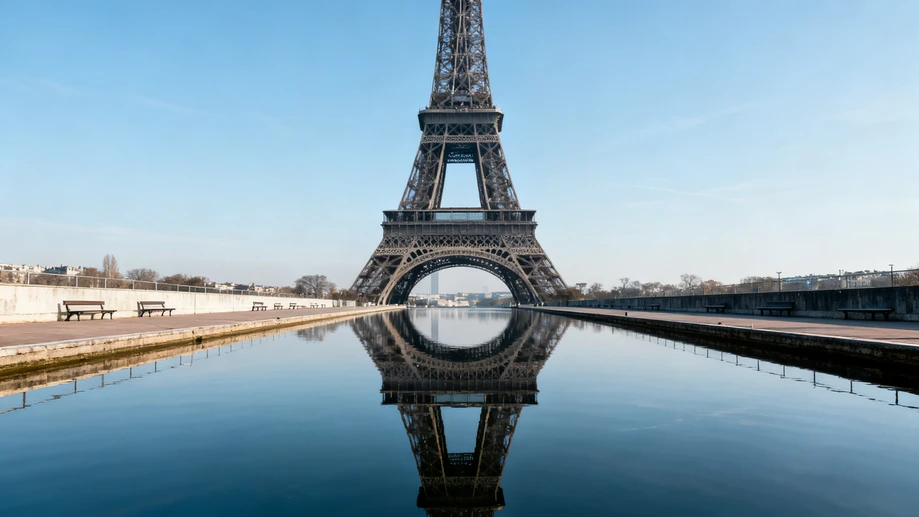
The vast majority of online travel guides recommend two overcrowded viewing spots, the center of Champ de Mars and the top of Trocadero steps, where you will struggle to find a clear frame free of other people and selfie sticks during peak visiting hours. There is a much less well-known hidden spot only 300 meters east of Jena Bridge on the left bank of the Seine, a low stone waterfront platform completely free of railings and mass tour groups. Standing on this flat platform, you can frame the full height of the Eiffel Tower alongside its complete undisturbed reflection on the smooth river surface, with no random street stalls or messy signs breaking the clean visual line. Around 5 p.m., the golden hour light will coat the entire iron structure with a soft warm orange hue, making the sharp geometric lines of the lattice look gently glowing against the pale blue sky.
A large number of tourists plan their schedules to wait for midnight sparkling light shows, but the best viewing experience actually falls on the very first sparkling show right after the sun fully sets, when the sky is still dyed a soft shade of deep lavender, and the street lights across the whole city just turn on one after another. The 20,000 small twinkling lights installed on the tower turn on at every hour on the dot after dark, running for exactly 5 minutes before fading out gently. You do not have to squeeze among hundreds of other people on Champ de Mars to catch the view, you can just sit on the flat stone steps of that hidden riverside platform, enjoy a fresh warm crepe you bought from a nearby street vendor, and let the cool breeze carrying faint water vapor from the Seine brush across your face. No one will rush you to leave, and you can listen to distant street musicians playing slow jazz while watching the whole 5-minute sparkling performance unfold in front of you, far away from the noise of crowded tourist zones.
When the last sparkling show of the night ends, do not follow the large flow of visitors straight to the nearest metro station immediately. Instead, take a slow stroll back to the inner paved path right at the foot of the tower, where the original 19th century vintage cast iron street lamps line both sides of the road, and the names of 72 prominent French scientists engraved on the iron frame of the tower are still clearly visible after more than a century of weathering. In late spring and early summer, the small enclosed garden around the tower is full of blooming pale pink climbing roses, whose soft petals occasionally fall onto the smooth stone steps when the wind blows. You do not need to purchase overpriced mass-produced souvenirs from nearby gift shops, just tuck one of the fallen rose petals into your notebook, and you will have a completely unique tiny memento of your trip that no other tourist will get the chance to bring home.