
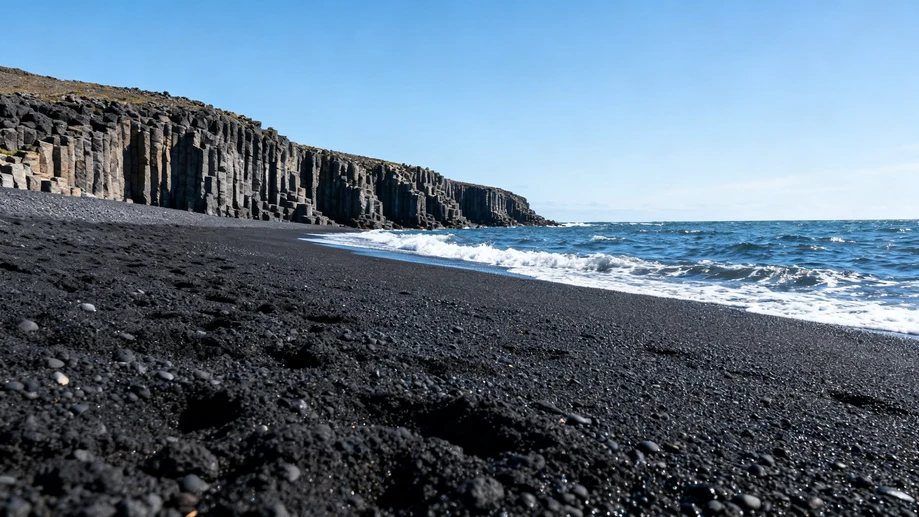
Wandering along dramatic jet-black volcanic shores of Iceland’s iconic Reynisfjara Black Beach in bright summer light
This travel guide walks you through unmissable sights, hidden tips and unique natural facts of one of Europe’s most jaw-dropping coastal destinations
The moment you step off the paved parking lot and set your first foot on Reynisfjara’s sand, you will find the material under your feet is nothing like the soft, fine white sand you have encountered at most tropical beaches. The grain feels slightly coarse and textured, like walking on finely polished obsidian fragments, and it leaves no stubborn dark stains on the sole of your shoe no matter how long you wander across the shoreline. The entire stretch of coast unfolds in a striking, almost surreal color contrast: the deep, unbroken charcoal black of the beach meets the rich cobalt blue of the North Atlantic waves, which roll steadily toward the shore and break into foamy white edges that fade away the second they touch the dark sand, leaving no trace of damp light-colored residue behind.
A short walk east along the shore leads you to the base of the towering basalt columns that line the back edge of the beach, the same geological formation that inspired the design of a globally famous concert hall decades ago. These near-perfect hexagonal stone pillars were not carved by humans, but formed when thick lava flows from ancient nearby eruptions cooled rapidly after hitting the cold ocean water, and cracked into regular geometric shapes as they contracted. One little known fact most casual tourists never hear from short travel itineraries: the black grains on this beach will never turn pale or fade to off-white after thousands of years of continuous wave erosion. Unlike most common beach sand that is made of low-density quartz that easily wears into light fine powder and washes away, these sand particles are pure high-density basalt fragments that are incredibly hard, and will only shrink very slowly over tens of thousands of years while keeping their deep, consistent black color.
Even with all its breathtaking scenic charm, this stretch of coast hides subtle potential dangers that every visitor needs to keep in mind the whole time they are exploring the area. The unpredictable sneaker waves that surge in from the open ocean far faster than most people can react have caught countless travelers off guard when they are distracted by taking photos or staring at the distant horizon, and the powerful undercurrent that follows these waves can drag unprepared people into frigid deep water in seconds. There are no professional lifeguards patrolling this coast due to the extreme strength of local currents, so the most responsible way to experience the beach is to stay at least 15 meters away from the tide line at all times, avoid wandering onto the wet slippery rock surfaces that are coated in invisible thin layers of seaweed, and never turn your back to the ocean for more than a few seconds.
If you lift your gaze from the shoreline and turn your back to the sea, you will see an equally stunning landscape that frames the black beach on its inland side. Patches of thick, velvety Icelandic moss cover the low rolling volcanic hills that rise a short distance away, and the faint outline of snow-capped peaks can be seen through gaps in the low hills on clear sunny days. In the peak of summer, the low-hanging midnight sun paints the top edge of every basalt column and the entire surface of the black sand with a thin layer of warm golden glow, which turns the usually stark dark shore into a soft, almost dreamlike scene that feels completely different from the bright midday view. In winter months, the dancing green and purple ribbons of the northern lights reflect softly on the smooth dark sand surface, making the faint glow of the aurora look far more vivid and bright than it does over ordinary light-colored beaches.
When the time comes to leave the coast and head back toward the nearby ring road, you will notice there are no crowded souvenir stalls, no loud beachside bars, no noisy beachside amusement facilities along the shore, keeping the whole landscape as unspoiled and quiet as it has been for hundreds of years. Local environmental protection rules ban visitors from taking even a tiny handful of black sand away from the beach, so the best way to carry the memory of this special place with you is to keep the feeling of cool clean sea wind on your face and the sight of the unmatched color contrast between black sand and blue ocean in your mind, a memory that will stand out far more than any mass-produced souvenir you could pick up on the way home.