
Secrets Beneath the Orange Blossoms: Uncovering Seville's Alcázar Palace
Where Moorish Sultans, Christian Kings, and Game of Thrones Collide in Andalusia's Living Time Capsule
As dawn paints Seville's sky in watercolor hues, the scent of orange blossoms guides you toward a fortress where history breathes through every archway. The Royal Alcázar stands not as a relic but as a living chronicle, its foundations laid by Moorish rulers in the 10th century. Wander through the Hall of Ambassadors where Queen Isabella commissioned Columbus' voyage, then trace your fingers over Quranic inscriptions beside Christian crests – a silent testament to Spain's layered past. This UNESCO site remains Europe's oldest royal palace still in use, hosting modern monarchs in rooms echoing with a thousand years of whispers.
Transition from the Gothic gloom of King Pedro's chambers into the sun-drenched brilliance of the Courtyard of the Maidens. Here, geometry becomes poetry: star-patterned tiles shimmer beneath horseshoe arches, while stucco walls bloom with honeycomb muqarnas vaulting. Notice how Islamic artisans incorporated Christian motifs after the Reconquista, creating the unique Mudéjar style that defines Andalusia. The deceptive simplicity of white plaster and red brick belies mathematical precision – each curve calculated to create illusions of infinite space and capture desert winds for natural cooling.
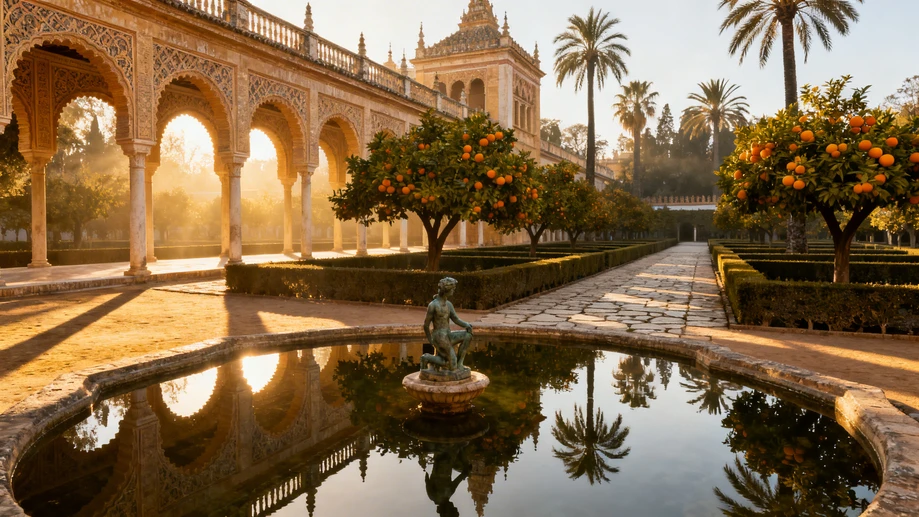
Beyond the palace walls awaits a botanical labyrinth defying Seville's arid climate. The sprawling gardens unfold like chapters of a horticultural epic, where Renaissance symmetry gradually yields to Romantic wildness. Follow the scent of myrtle to Mercury's Fountain, its reflection shimmering in a pond stocked with descendants of fish bred for Moorish caliphs. Tropical palms tower over European herb gardens, while hidden grottoes offer sudden, cool respite. This is no mere ornament: the underground "water gardens" engineered by 12th-century hydrologists still nourish 170 plant species through gravity-fed channels.
Modern visitors might recognize the Baths of Lady María de Padilla, where subterranean vaults doubled as the Water Gardens of Dorne in Game of Thrones. Yet the Alcázar's true magic lies in accidental discoveries – like the recently unearthed 11th-century hammam whose steam rooms reveal how medieval bathers socialized. As you exit through the Lion Gate, ponder this: the orange trees shading your path were originally imported from Asia as medicinal plants before becoming Seville's signature fragrance. Their bittersweet fruit remains unpicked, left to carpet the ground in golden tribute to the palace's eternal cycle of renewal.