
Unveiling Amsterdam's Golden Secret: The Rijksmuseum's Timeless Treasures
Beyond Windmills and Canals Lies a Dutch Masterpiece Housing Centuries of Artistic Genius
Amsterdam's Museumplein square pulses with cultural energy, but one building commands attention like no other. The Rijksmuseum stands as a sandstone fortress of art, its Gothic and Renaissance revival architecture framing arched passageways where cyclists stream beneath stained-glass windows. This isn't merely a museum; it's a time capsule where the Netherlands' golden age breathes through every gallery. Visitors approach beneath a canopy of bicycles - that quintessential Amsterdam sight - before stepping into a cathedral of creativity where light floods through vaulted ceilings onto masterworks that shaped European art history.
Transitioning from the sunlit atrium to the Gallery of Honour feels like crossing into another dimension. The hall narrows dramatically, drawing eyes toward a distant focal point: Rembrandt's monumental masterpiece, "The Night Watch." Along this processional route, Vermeer's "The Milkmaid" radiates quiet intensity in her corner alcove, while Van Gogh's early self-portrait reveals the artist's struggle before his signature style emerged. What surprises many is how these iconic works coexist with extraordinary decorative arts - Delftware tulip vases shimmering beside intricate dollhouses that once belonged to wealthy merchants. The museum's genius lies in this contextual storytelling, where paintings converse with period furniture and ship models to recreate entire eras.
Few know that the Rijksmuseum pioneered an ingenious restoration approach for "The Night Watch." When conservators discovered Rembrandt had originally painted the masterpiece with an arched top, they made the bold decision not to recreate missing sections. Instead, they mounted smaller panels on both sides displaying the full original composition through digital reconstruction, creating a fascinating dialogue between seventeenth-century technique and twenty-first-century technology. This reverence for authenticity permeates the entire institution, where even the building's 2013 renovation meticulously preserved Pierre Cuypers' original 1885 design while creating revolutionary new exhibition spaces beneath the courtyard.
Wandering through the Asian Pavilion reveals unexpected connections between Dutch trade and Eastern artistry. Here, a delicate Japanese kimono worn by a wealthy Amsterdammer rests near lacquerware collected when the Netherlands was Europe's gateway to Asia. The building itself becomes part of the narrative - sunlight filters through a glass ceiling onto a stone Buddha, while reflecting pools mirror centuries-old temple sculptures. This seamless integration of old and new reaches its zenith in the library, a breathtaking neo-Gothic study hall with cast-iron railings and tiered wooden bookshelves rising three stories toward a stained-glass roof.
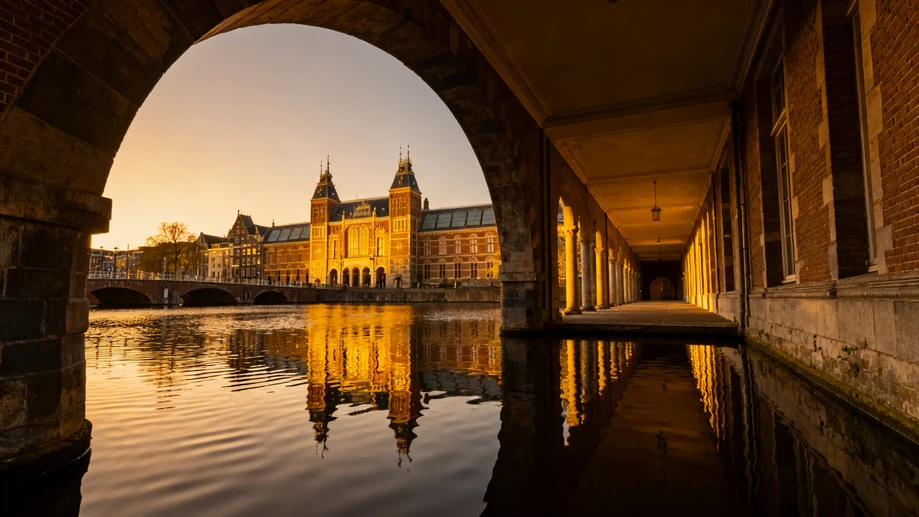
As daylight fades, the museum's magic transforms. Golden hour illuminates the building's façade with honeyed light while the adjacent canal mirrors its turrets and spires. Inside, the Gallery of Honour takes on a sacred aura as spotlights intensify the drama of Rembrandt's chiaroscuro. Visitors linger before Frans Hals' laughing cavaliers, their brushstrokes seeming to dance under focused illumination. Emerging hours later into Amsterdam's twilight, one carries not just memories of art, but an understanding of how a small nation's ambition and artistry forever changed the world's visual language.