
Eight Million Gallons a Day: Yellowstone's Hidden Water Ballet
Where boiling rivers meet glacial lakes in America's first national park
Beneath the vast Wyoming sky lies a landscape that seems borrowed from another planet. Yellowstone National Park isn't just America's first national park – it's a living laboratory where water dances in impossible ways. Here, clouds of steam rise like ancient ghosts from over 10,000 hydrothermal features, painting the air with the scent of minerals. The park's vast wilderness stretches across three states, yet its geothermal heart beats strongest in these valleys where the earth's crust is whisper-thin. Every curve in the boardwalk reveals new wonders: turquoise pools deeper than imagination, mud pots bubbling like chocolate fountains, and terraces of gleaming mineral deposits stacking towards the sky. This is nature's theatre, and the curtain never falls.
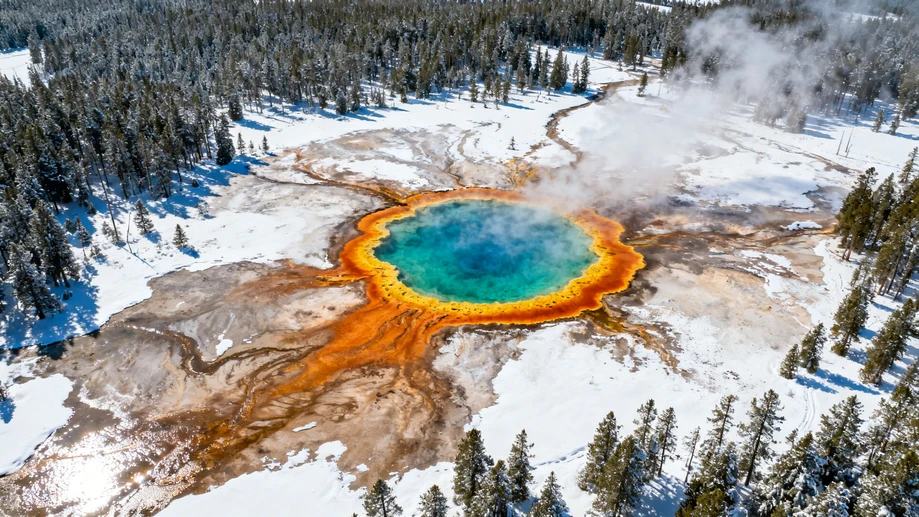
Witnessing Old Faithful's punctuality feels like watching celestial clockwork. Every 90 minutes, without fail, the geyser sends a tower of scalding water 130 feet skyward as crowds gasp in unison. But the real magic lies beyond the famous performers. Wander along the Fountain Paint Pots trail where thick mud bubbles and pops like primordial oatmeal, creating surreal sculptures that change by the hour. Nearby, the Grand Prismatic Spring unfolds as Earth's largest hot spring – a 370-foot-wide chromatic marvel where thermophiles paint concentric rings of electric blue, searing orange, and rusty red. These microorganisms thrive where humans would perish, transforming lethal heat into vivid art.
Yellowstone's waters perform astonishing transformations beyond the geyser basins. The Firehole River gathers steaming tributaries until its currents become bathtub-warm, nurturing rainbow trout year-round. By contrast, the Gibbon River plunges through icy canyons where waterfalls freeze into crystalline curtains each winter. This hydrological magic peaks at the Continental Divide, where raindrops decide their ocean destiny. At Isa Lake, water flows both east toward the Atlantic and west toward the Pacific simultaneously – a rare hydrological oddity that underscores Yellowstone's capacity for quiet surprises.
Few visitors realize they're standing atop one of Earth's largest active volcanoes. The Yellowstone Caldera stretches 45 miles wide, its hidden magma chamber fueling the park's geothermal wonders. Here's a fascinating detail: The park's waters recycle with astonishing speed. Every day, eight million gallons of scalding water erupt from geysers or seep through thermal features, only to be replenished by annual snowfall equivalent to 53 inches of rainfall. This constant renewal creates a self-sustaining aquatic ballet that's performed daily for millennia. Underground, superheated water races through rock fractures at temperatures exceeding 400°F before bursting skyward in spectacular displays.
Winter unveils Yellowstone's most dramatic metamorphosis. Steam rises thicker in the frosty air, enveloping bison in vapor halos as they plow through snowdrifts near the Madison River. Frozen geyser cones resemble intricate wedding cakes, while mineral-laden waters create ice formations in impossible shades of jade and saffron near Mammoth Hot Springs. Ranger-led snowshoe tours reveal animal tracks like wilderness calligraphy – wolf prints circling elk herds, otters sliding into steaming rivers. This frozen season showcases the park's raw power most vividly, where fire and ice exist in breathtaking equilibrium.
Preserving this delicate balance remains Yellowstone's eternal challenge. Rangers educate visitors about the fragile bacterial mats coloring hot springs – stepping off trails can destroy centuries of microbial growth. The park's "thermal etiquette" rules protect both people and features, as thin crusts hide boiling water beneath. Recent initiatives include solar-powered facilities and restricted vehicle access during sensitive wildlife seasons. As climate patterns shift, scientists closely monitor snowpack levels that feed the park's intricate water systems. These efforts ensure that the world's first national park continues its water dance for generations yet unborn.
Beyond its famous geysers, Yellowstone guards less-celebrated hydrological secrets. At Dragon's Mouth Spring, thunderous belches echo from a watery cave as if the mountain itself were breathing. Mysterious Fumarole Creek runs entirely hot, its steam-wreathed course through Lodgepole pines creating an elven atmosphere. Then there's the peculiar case of hot spring silica. As mineral-rich waters cool, they deposit microscopic quartz crystals that build terraces so white they hurt the eyes under summer sun. This dazzling silica – the same substance found in glass – sculpts landscapes that glitter like alien jewelry. Visiting Yellowstone isn't just tourism; it's immersion in Earth's living chemistry lab.