
Have You Ever Wondered What Lies Beneath These Red Rock Giants?
A Journey Into Arizona's Secret Light Show Carved Over Millennia
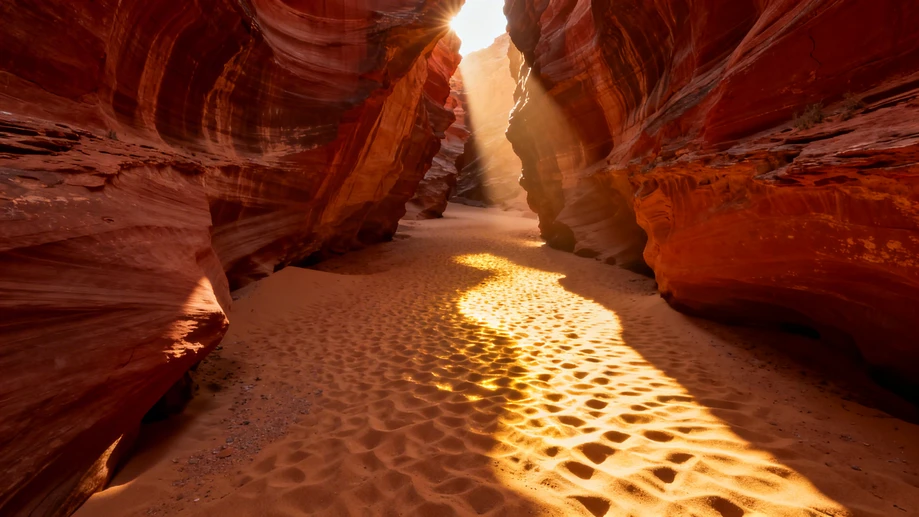
Imagine stepping into a cathedral sculpted not by human hands, but by the patient artistry of wind and water over 190 million years. The moment you descend into Upper Antelope Canyon near Page, Arizona, the outside world vanishes. Walls of undulating sandstone, glowing in hues of fiery orange and deep burgundy, rise hundreds of feet on either side, narrowing to reveal a sliver of sky far above. This slot canyon, sacred to the Navajo people, feels like walking through a living painting where sunlight dances on the ancient rock in liquid gold waves.
Formation of this geological wonder began when Jurassic sand dunes compacted into solid rock. Later, ephemeral flash floods – rare but violently powerful – carved through the soft Navajo Sandstone like a hot knife through butter. The result is a sinuous, narrow passage less than ten feet wide in places, adorned with impossibly smooth, rippled surfaces. Guides often point out shapes resembling eagles, bears, or flowing curtains frozen in stone, inviting visitors to see the canyon’s own silent storytelling written in its curves.
Photographers flock here for the legendary "beam season." Between late March and early October, around midday, sunlight aligns perfectly with the canyon opening. This creates dramatic, narrow shafts of light that pierce the dust-filled air, illuminating particles like stardust. Local Navajo guides expertly toss handfuls of fine sand to enhance these ethereal beams, transforming the canyon floor into a stage for nature’s light ballet. A fascinating detail often missed: the seemingly purple tint on some walls isn’t shadow, but oxidized manganese mineral deposits revealing the canyon's complex chemical history.
Beyond the visual spectacle, Antelope Canyon resonates with profound cultural significance. The Navajo, or Diné, call it Tsé bighánílíní, "the place where water runs through rocks." For generations, they understood the canyon's moods and dangers, navigating its mysteries long before it became famous. Visiting with a licensed Navajo guide isn't just practical for safety; it provides invaluable insight into the spiritual connection between the land and its original stewards, transforming a sightseeing trip into a deeper cultural encounter.
Visiting requires planning. Unlike sprawling national parks, access is strictly controlled through guided tours due to the canyon’s fragility and flood risks. Summer brings intense heat and crowds seeking the light beams, while winter offers cool serenity and softer, diffused lighting highlighting subtle textures. The quiet moments just before sunset, when the crowds thin and the canyon walls deepen into rich, velvety reds, hold a uniquely intimate magic.
Stepping back out into the Arizona desert feels like re-emerging from another world. The stark contrast between the wide-open plateau and the hidden, sinuous beauty below underscores Antelope Canyon’s extraordinary nature. It serves as a humbling reminder of time’s immense scale and water’s quiet power – not just a geological marvel, but a masterpiece etched patiently across epochs, waiting to astonish those who venture within.