
Yellowstone's Geysers Erupt with Wonder and Wild Beauty!
Editorial Team
VerifiedSenior Correspondent
Yellowstone's Geysers Erupt with Wonder and Wild Beauty!
Exploring the geothermal wonders of America's first national park where nature paints its masterpiece
Steam rises like ghostly dancers from the earth's core as you stand on the boardwalk, surrounded by hissing fumaroles and bubbling mud pots. Yellowstone National Park isn't just another scenic destination; it's a living laboratory where the planet reveals its fiery heartbeat beneath your feet. Established in 1872 as the world's first national park, this sprawling wilderness straddling Wyoming, Montana, and Idaho protects over 2.2 million acres of geothermal drama, alpine rivers, and petrified forests. The scent of sulfur hangs in the crisp mountain air, a constant reminder that you're walking atop one of Earth's largest active volcanic systems where underground magma chambers fuel over 10,000 hydrothermal features.
All eyes turn toward Old Faithful as anticipation builds among the crowd gathered on weathered benches. Right on schedule, a thunderous roar announces the spectacle as scalding water rockets 130 feet skyward, defying gravity for nearly five minutes. What makes this geyser extraordinary isn't just its reliability—erupting every 60-110 minutes like clockwork—but how it demonstrates nature's perfect engineering. Rainwater seeps through limestone bedrock, superheats in volcanic chambers, then explodes through constricted rock formations. Interestingly, park rangers can predict eruptions with 90% accuracy within ±10 minutes by monitoring underground water temperature fluctuations, turning each performance into a thrilling lesson in geothermal physics.
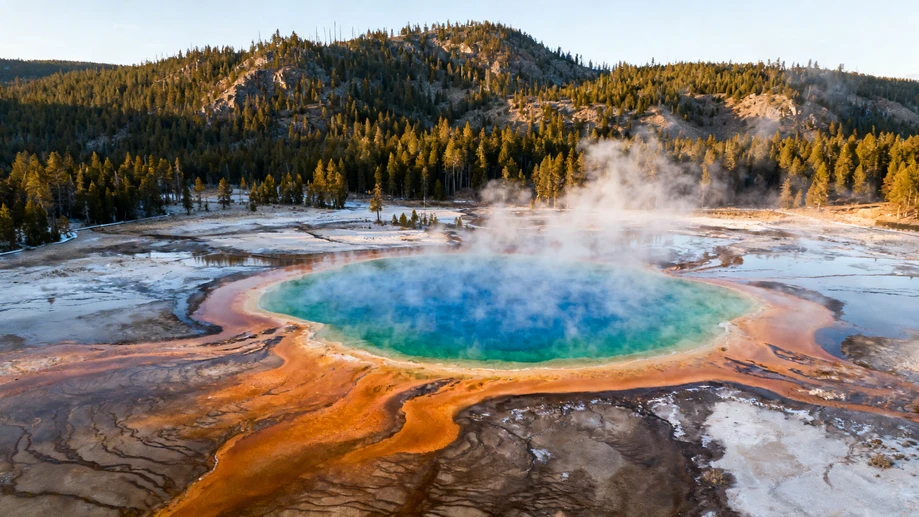
Beyond the iconic geysers lies a kaleidoscope of hydrothermal surprises. The Grand Prismatic Spring stretches wider than a football field, its concentric rings of electric blue, emerald green, and burnt orange created by heat-loving microorganisms called thermophiles. At Mammoth Hot Springs, mineral-rich waters cascade over travertine terraces, building luminous white formations resembling frozen waterfalls. The park even holds a quirky secret: Yellowstone Lake's underwater geysers remain among Earth's least explored frontiers, with recent expeditions revealing bizarre microbial life forms thriving in near-boiling acidity. Hidden within this geothermal wonderland sleeps a sleeping giant—the Yellowstone Caldera. Measuring 45 by 30 miles, this supervolcano last erupted 640,000 years ago and contains enough magma to fill the Grand Canyon eleven times over.
Suddenly, a traffic jam forms not from vehicles but from a bison herd crossing the Lamar Valley at dusk. Often called America's Serengeti, these grasslands teem with wildlife against the backdrop of snow-dusted peaks. Bald eagles circle above steaming rivers thick with cutthroat trout, while elusive gray wolves patrol distant ridges restored to the ecosystem in 1995. Spotting a grizzly requires patience and binoculars, but witnessing a mother teach cubs to dig for tubers rewards those who rise before dawn. Rangers emphasize the golden rule: maintain at least 100 yards from wolves and bears, using zoom lenses instead of footsteps for intimate encounters.
Preserving Yellowstone demands collective responsibility as climate change reshapes its ecosystems. Warmer temperatures already threaten geyser activity by reducing snowpack that feeds groundwater, while invasive lake trout devour native cutthroat populations. Visitors become guardians by staying on boardwalks to protect fragile bacterial mats that take centuries to form, packing out all trash, and using bear-proof storage. The park's beauty transcends postcard views; it offers a humbling encounter with the planet's raw power where wolves howl at midnight steam plumes and bison wander through kaleidoscopic hot springs.